





What Factors Affect the Accuracy of a Temperature Gauge?
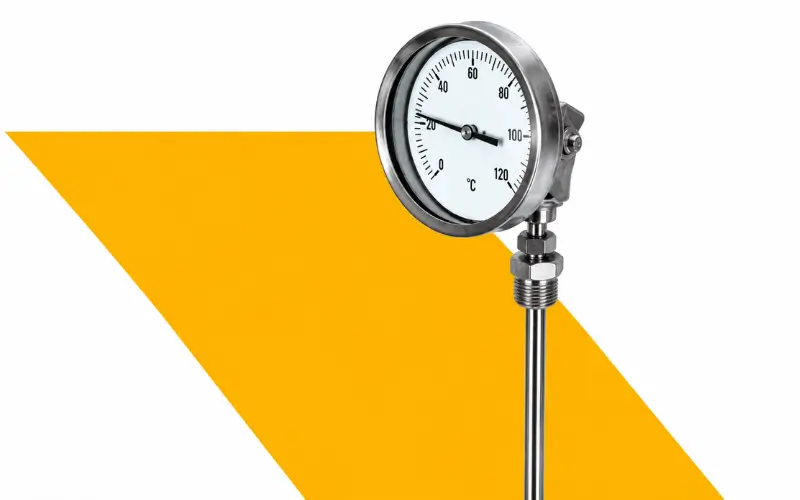
Simple on the outside, a thermometer consists of a stem extending into a process, a pointer and a dial. But what number the pointer lands on is dependent on a surprising number of things going right. There are also several factors to consider, including calibration, how the gauge is attached, environmental conditions, and the immersion depth of the stem, and any of these can cause a reading error even if the gauge is truly manufatured correctly.
How a Temperature Gauge Works
Most industrial temperature gauges are not electronic. For example, a bimetallic thermometer is a combination of two strips of metal stuck together, each with a different rate of thermal expansion. The strips expand and contract at different rates when heated and cooled, so when heated, one will do so more than the other; they are wound into a coil and this causes a twisting movement, which moves a pointer across a dial that has been calibrated. One of the reasons bimetallic gauges are still in use in industrial applications where simplicity and reliability are more important to the process than digital accuracy is that no external power source is required.
Both gas and liquid expansion thermometers are based on a similar principle, but the fluid or gas expands inside the measuring system to move the pointer, and these are generally used to expand the range beyond the comfortable level of the bimetallic design.
Since the entire mechanism is based on physical expansion and mechanical linkage, anything that hinders the expansion, or misreads it, is a source of error.
Installation Factors That Influence Accuracy
Mounting Orientation
Usually, gauges come in a range of mounting options, such as bottom entry, back entry and all angle entry types. The wrong orientation for a specific installation can create unnecessary mechanical stress on the stem and/or make it hard to read the dial from an operator position which can have a negative impact on the ability to check and maintain the gauge accurately.
Process Connection and Thread Type
Gauges are secured to a process through BSP or NPT threads, and if they are not matched, then they may leak, have an improper seat, or improperly seat the stem in the process. When a connection is matched correctly the sensing part of the stem is maintained in just the right position with respect to a measured fluid or gas.
Stem Length and Hex Size
The sensing portion should be long enough to ensure that the portion of the stem which is in contact with the process is sufficiently removed from the boundary layer near the pipe or tank wall so as to represent the actual process temperature and not the boundary layer temperature. Tempsens can customize stem lengths from 65mm to 1000mm, and stem diameter outer diameter can be customized to 6mm, 8mm, 10mm, 12mm, matching the actual diameter of the pipe or tank to be immersed, to prevent the performance of different lengths from the same model of stem in different applications to be incompatible.
Use of a Thermowell
A thermowell is used to isolate the process from the gauge where it is exposed to high velocity flow, corrosive process media, or high pressure. This also makes it possible to easily remove and service the gauge without disrupting production, ensuring that calibration checks and replacements are not a larger maintenance event than necessary.
Stem Immersion
The immersion of the stem of the gauge in the process fluid or gas being measured. If the stem is not placed deep enough into the process, heat can flow down the stem to the cooler air around the pipe or tank, which will cause the reading to be lower than the actual process temperature. Known also as stem conduction error, this effect is greater in smaller stems and/or large temperature differences between processes and ambient.
For this reason it is important that the stem length is not selected just to fit the application, but rather that it fits the application. Even if the gauge mechanism is operating, a short stem will always under read for a large pipe or deep tanks.
Ambient Conditions and Their Effect on Readings
The accuracy can be affected not only by the process being measured but also by the environment in which the gauge is placed. In both the gas and liquid expansion gauge types, extreme ambient temperatures, either hot or cold, can cause the internal mechanism and/or dial housing to be affected, especially when ambient temperatures are subjected to sealed system interaction. One reason for the inclusion of over-range protection in many designs of industrial gauges is that vibrations from the machine nearby will cause poor pointer stability and mechanical wear over time even if they are within the 120% full scale range. This is to prevent permanent mechanical damage during abnormal temperatures changes and not only accuracy drift when normal operation.
Material Selection and Its Role in Long-Term Accuracy
The ability of a gauge to resist corrosion over time is influenced by wetted parts and casing materials; and corrosion damage to the stem or sensing element can manifest as measurement error. Tempsens produces a variety of gauges in SS316 wetted parts and SS304 casing as standard, providing corrosion resistance and cost balance for most industrial applications, or special coatings can be used in more aggressive chemical applications. A slow corrosion rate can lead to accurate performance, even though it will not prevent failure; this is why material selection is not only a factor against corrosion but a factor of accuracy as well.
Standards Worth Checking Before Installation
Gauges manufactured to known standards provide greater confidence in the accuracy statements made. Ensure to check conformance to EN13190 for bimetallic accuracy class and conformance to a wider range of gauging standards like IS3624, EN837 and ASME B40.3 for construction, dial size and general performance expectations in the industry. Other applications may require other types of certification for gauges used in hazardous, sanitary or high pressure applications.
Final Thoughts
The accuracy of the thermometer is not solely determined by its dial’s inner workings. The number on the dial is only accurate if the calibration status, as well as mounting options such as mounting direction and stem depth, the processing depth of the stem, and the environment around the gauge. It is these factors that need to be considered when selecting and installing a temperature gauge, and not treating it as a plug and play device to keep readings accurate over time.
Read Also: Karama Medical Fitness Center: Timings, Location, Fees, Services and Visa Medical Test