

Financial Centre Metro Station – Location, Facilities, Timings & Nearby Attractions

It requires efficient public transport systems in modern cities. Metro machines can assist in the reduction of traffic and make people travel more quickly. The Red Line of Dubai is significant and has the Financial Centre Metro Station. It links business regions, offices, and financial firms to the passengers. The station is situated on one of the busiest roads in Dubai, the Sheikh Zayed Road. Quite a number of people who access this station daily are office workers, tourists, and residents.
The station is near corporate offices, luxury hotels, and cultural attractions. It is due to this central location that it remains busy most of the time. One of the greatest rail systems in the UAE is the Dubai Metro. It is a safe and fast means of travel that is automated. Such stations make people access financial sectors conveniently. This guide describes the location of the station, the facilities, places nearby, transport connection and tips on travelling.
Overview of the Station
The Red Line of the Dubai Metro serves the Sheikh Zayed Road and connects the most significant areas of the city. What makes the station interesting is that it is located between the Emirates Towers Station and Burj Khalifa/Dubai Mall Station, which is also one of the key business streets.
It mostly caters to the Dubai International Financial Centre (DIFC), which is an international financial center that has international banks, investment firms, law firms, and multinationals. Due to that, the station is often attended by work-related professionals who travel to work.
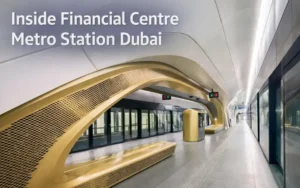
The design is based on the current modern language of Dubai Metro with clean lines, glass exterior, air-conditioned interiors, and advanced passenger systems. The station is completely automated, and it does not require train drivers; instead, it has centralized control systems.
Traveling on the Nol cards, escalators, elevators, clear signs, and security cameras allow passengers to experience a hassle-free ticketing process. These characteristics allow preserving an effective movement of people even in rush hours.
Dubai Metro Red Line – Typical Operating Schedule (Financial Centre Area)
| Day | First Train | Last Train |
| Monday | 05:00 AM | 12:00 AM |
| Tuesday | 05:00 AM | 12:00 AM |
| Wednesday | 05:00 AM | 12:00 AM |
| Thursday | 05:00 AM | 12:00 AM |
| Friday | 05:00 AM | 01:00 AM (Next Day) |
| Saturday | 05:00 AM | 12:00 AM |
| Sunday | 08:00 AM | 12:00 AM |
Location and Accessibility
The Financial Centre Metro station is based at the central business district of Dubai on Sheikh Zayed Road. It is marooned near the Dubai International Financial Centre neighborhood and is within easy access to some of the commercial towers, hotels, and government offices.
The district is characterized by a high level of concentration of corporate headquarters and financial institutions. Due to this fact, the station is especially busy during rush hours on working days when professionals travel to and out of the financial district.
Within the station, passengers can access:
- Dubai International Financial Centre (DIFC)
- Emirates Towers
- Downtown Dubai
- Trade Centre area
- Sheikh Zayed Road business hub.
Taxi, pedestrian walkways, and buses link the station to the office complexes and residential houses around. This makes it user-friendly to the commuters who may be employed in the nearby towers, but may wish to use the public means of transport rather than driving.
Station Layout and Facilities
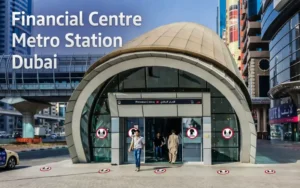
The station is user-friendly and convenient for the passengers. Similar to the vast majority of Dubai Metro stations, it has an elevated structure that runs along Sheikh Zayed Road.
The station will also have large concourses, ticket booths, automated machines, and waiting platforms inside the station. The design of the building will allow passengers to travel in a short time between the entrances, ticketing, and the train platforms.
Common facilities include:
- Ticket-selling machines and NOL card recharge machines.
- Customer service counters
- Accessibility by means of escalators and elevators.
- Good navigation signs, both English and Arabic.
- Waiting in air-conditioned bays
- Small convenience retail kiosks.
The security and surveillance systems are available round-the-clock to provide safety to the passengers. The employees are on hand to guide the travelers in case they require directions, ticket assistance, or accessibility.
Dubai Metro stations are planned in such a way that they meet the universal accessibility criteria, and passengers with disabilities or mobility issues can use them conveniently.
Metro Line and Operating Details
The station runs on the Red Line of the Dubai Metro. It is one of the busiest and longest lines in the network. It links various significant sites in Dubai. These are the Dubai International Airport, business hubs, residential places, as well as shopping areas. These links also make the metro be used by many commuters and visitors on a daily basis.
Financial Centre Metro Station is a metro station on the Sheikh Zayed Road that is an elevated one, which is adjacent to the DIFC area. It primarily caters to business people, office employees, and tourists who visit the surrounding business centers. The station is operational throughout the day, and it is based on the Nol Card ticket system that allows passengers to be charged for using the metro and any other public transport services in Dubai.
Dubai Metro Fare (Financial Centre Area)
| Ticket Type | Travel Distance | Price (AED) |
| Standard Silver Nol Card | 1 Zone | 3 AED |
| Standard Silver Nol Card | 2 Adjacent Zones | 5 AED |
| Standard Silver Nol Card | More than 2 Zones | 7.5 AED |
| Gold Class Nol Card | 1 Zone | 6 AED |
| Gold Class Nol Card | 2 Adjacent Zones | 10 AED |
| Gold Class Nol Card | More than 2 Zones | 15 AED |
Transport Connections Around the Station
Integrated with other means of transport, the metro system is most effective. Several other transport systems are linked to the station, enabling the passengers to continue their travel without any problems.
The commuters usually use the metro, buses, taxis, or ride-hailing services.
The major transportation links are:
- Taxi posts are outside the exits of the station.
- Public bus stops in the surrounding districts.
- Footways to the surrounding towers.
- Ride-hailing pickup points
- Availability of transport routes on Sheikh Zayed Road.
These links enable the passengers to move outside the metro route and to places that are not directly covered by rail.
The transport network in Dubai is an integrated network with metro, buses, and taxis that have been planned to complement mobility in the city.
Importance for Business Travelers
The area around the station is also among the most powerful financial locations in the Middle East. The region is home to many international banks, asset management firms, consulting firms, and fintech startups.
The people who work in such offices use the metro to go to work on a daily basis. The metro contributes to the reduction of traffic congestion along the Sheikh Zayed Road, which is among the busiest roads in the UAE.
Dubai is home to business travelers who frequently utilize the metro to get to a meeting or conference in the DIFC region. The location also enables the visitors to be able to go on the red line to the financial district fast and easily because the station is located close to the airport.
The metro station has also become an essential infrastructure in the employee commute at the workplace to many companies based in the surrounding area.
Nearby Attractions and Landmarks
There are many significant attractions and landmarks within walking distance or within a short taxi trip of the station. This renders this a place attractive to office workers, as well as to the tourists and residents who visit the city.
Notable locations in the neighborhood are:
- Dubai international financial centre (DIFC) gate village.
- Emirates Towers
- Museum of the Future
- Downtown Dubai district
- Burj Khalifa area
- Dubai World Trade Centre
Such landmarks are luxury hotels, art galleries, restaurants, and corporate headquarters. In most cases, financial district walking tours are accompanied by the metro.
Due to the integration of business and cultural experiences in the area, professionals, tourists, and those who attend events come there all year round.
Travel Tips for Commuters
Otherwise, it is possible to make the journey of travelers easier by considering some practical principles when using the metro station.
The commuter tips of help would include:
- Whenever feasible, have to travel during off-peak hours.
- Recharge Nol cards outside the station.
- Take directional signs to exit fast to DIFC.
- Take elevators when carrying luggage or heavy bags.
- Keep out of the way of trains when they come.
These practices are easy to observe and ensure that there is no congestion at the points of entry and exit by passengers as well as a decrease in waiting time, particularly during peak workdays.
The commuters can also get used to the exits and timing of the trains they usually use, depending on their daily routine.
Urban Development Around the Station
Metro stations tend to encourage the development of urban areas around them,m and so is this place. The surrounding environment of the station has been undergoing constant growth and transformation in terms of commercial real estate, hospitality,y and mixed-use towers.
The closeness of office buildings to the station makes multinational corporations interested in it because of easy access by transportation. The Red Line allows employees to commute to their workplaces without having to use a car, especially in most of the residential areas.
This has also seen the rise of luxury hotels and serviced apartments around the area to cater to business travelers who are visiting the financial district to attend meetings and conferences.
The availability of public transportation significantly determines the development of modern cities, and the long-term growth of the surrounding business environment depends on the existence of such kinds of stations.
Passenger Experience and Efficiency
Dubai Metro has the reputation of having clean, structured, and technologically improved infrastructure. Automated train system, accurate time schedules, and modern facilities are a gain to the passengers passing through the station.
There are extra-large digital screens where real-time updates regarding the arrival of trains and the services are posted. Travelers can also have access to station personnel who can guide them whenever required to make their travel smooth, both for residents and tourists.
The design is also passenger-focused by having climate-controlled interiors, broad walkways, and properly spaced platform layouts.
Due to the full automation of the metro, the trains run with regular intervals and less time wastage. This is one of the reasons why the metro is more favored by most professionals compared to commuting to work with heavy traffic in the cities.
Role in Dubai’s Public Transport Network
The transportation strategy of Dubai is aimed at decreasing the use of personal cars and promoting the adoption of public transport services.
The Metro stations in the central business districts can contribute to this aim by offering alternatives to road travel that are fast. The metro enhances the movement within the city by linking major business areas, residential areas, and tourism centers.
Financial Centre Metro Station is significant in this system due to its proximity to major corporate and financial institutions.
With the ongoing development of Dubai as a global financial centre, transport infrastructure will also be critical in sustaining the movement of the workforce and economic operation.
Conclusion
The transport system is critically important to the contemporary urban lifestyle, and this is especially true in the cities that have fast-developing business hubs. The Financial Centre Metro Station is a fundamental gateway to one of the most significant business districts in Dubai.
It is positioned on the Sheikh Zayed Road, making it reachable to most corporate offices, financial institutions, and other landmarks. The station assists thousands of people in traveling daily with effective train services, state-of-the-art amenities, and easy transportation links.
The station offers convenient and reliable means of transport to professionals in the financial area, tourists visiting the central part of Dubai, and residents who travel all over the city.
Since the UAE is still investing in infrastructure and smart mobility solutions, metro stations such as this will continue to feature in the vision of the country in terms of sustainable urban development and efficient people transportation.
FAQs
Where is the Financial Centre Metro Station located?
It is situated on the Sheikh Zayed Road in the central part of Dubai near the Dubai International Financial Centre (DIFC) business district.
Which metro line serves the station?
The station is located on the Red Line of the Dubai Metro system.
What are the nearby landmarks?
Some of the nearby landmarks are DIFC Gate Village, Emirates Towers, Museum of the Future, and Downtown Dubai.
What type of tickets are used in the Dubai Metro?
Nol cards are rechargeable smart cards that passengers use in the metro, bus,s and other transport services.
Is the station accessible to people with disabilities?
Yes. The station has lifts and escalators and convenient routes for passengers with mobility issues.
What transport options are available outside the station?
The passengers are able to use taxis, buses, ride-hailing services, and walking tracks to the adjacent buildings.
Who mainly uses this station?
Office workers, business travelers, tourists, and residents on their way to the financial district are using the station intensively.