





Blackout Curtains vs Blackout Blinds: Which Works Better for Dubai Homes?

July and August highs in Dubai average around 40°C, and in June the sun can rise as early as 5:27 a.m. For people who live behind large panes of glass this means that their bedrooms become too bright too early in the morning and their living rooms continue to absorb heat while the air conditioning has to work hard. It’s simple enough to decide to block out the light, but it’s when choosing between blackout curtains and blackout blinds that most houseowners find themselves stuck.
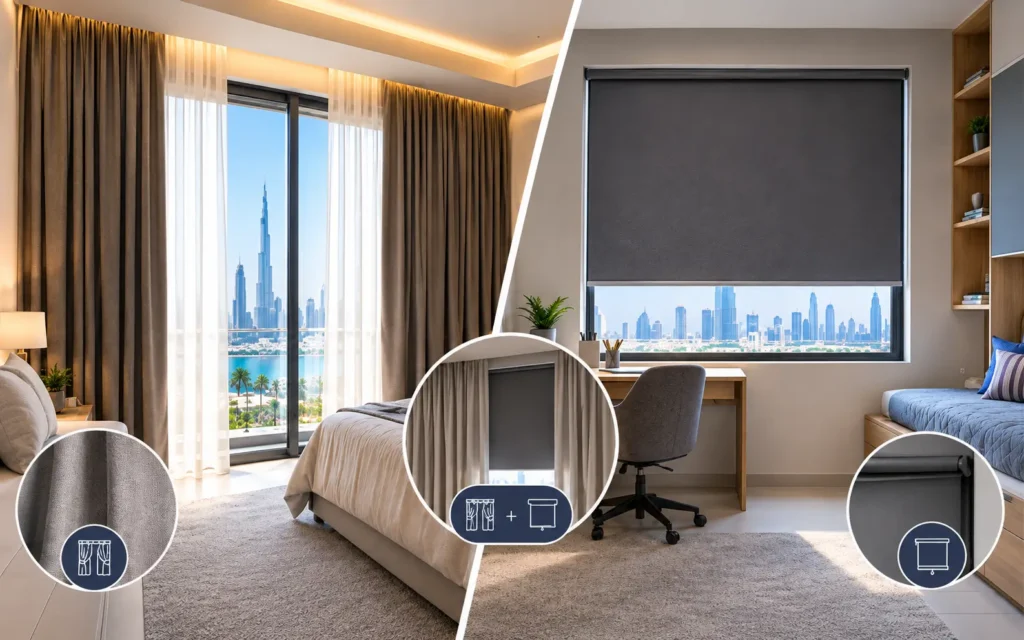
To sum up, blackout curtains are appropriate for wide windows, sliding doors, and bedrooms in which you desire a soft and layered appearance. Blackout blinds, on the other hand, are suitable for smaller windows, home offices, and children’s rooms where a slim and low-maintenance solution is more important. In a great many bedrooms in Dubai, the darkest and coolest effect is achieved by using both.
Why Light and Heat Control Matter More in Duba
Normal curtains have the effect of filtering light, but they offer little protection against the sun shining on the west- and south-facing glass for several hours each afternoon or on east-facing bedrooms at sunrise. Apartments situated on tall buildings have their own set of problems: they have floor-to-ceiling windows, neighbouring buildings which remain lit all night, and street lighting that never turns off.
The impact of the right window covering on heat is also significant. Advice on energy efficiency from the U.S. Department of Energy is consistent in this regard: closing drapes or blinds on windows that face the sun reduces solar heat gain, and light-coloured or reflective surfaces are most effective. However, the results will vary depending on your type of glass, the direction the window faces and the fabric used, so consider any savings as being only advisory and not certain. The general rule remains that the less sunlight which passes through the window, the less work your air conditioning has to carry out.
Where Blackout Curtains Win
- Large openings: sliding doors with full-height glass, which are typical in apartments and villas in Dubai, can be covered with a single pair of curtains rather than with several blinds placed side by side.
- Softer rooms. Since heavy fabric takes in some of the echo, this is useful in rooms which have marble or tiled floors.
- Layering involves using a blackout curtain together with a sheer curtain on a double track, which provides daytime privacy while diffusing the light and ensures complete darkness at night; this is the reason why blackout curtains in Dubai are especially effective when used with a sheer in bedrooms that face neighbouring towers.
- An insulating buffer, which is hung from a ceiling track and hangs down to the floor, has curtains that trap a layer of air between the glass and the room.
The disadvantages include the fact that the curtains require wall space on both sides in order to be able to fold back when they are open, light leaking around the top and sides if the track is fitted too low or too narrow, and the fabric picking up the fine dust which Dubai homes have to cope with all year, so it is necessary to plan for regular washing or having the curtains professionally cleaned.
Where Blackout Blinds Win
- There is a lack of space. The blinds are positioned close to the window, which is useful when there are beds or desks behind them or in small rooms where the curtains would obstruct things.
- It is easy to clean. Instead of having to take them down, many blackout blind fabrics, for example those made of polyester, can be dusted or vacuumed while in place.
- They have a neat and up-to-date appearance and are suitable for minimalistic interiors since they don’t include any extra fabric.
- For controlling glare, in home offices and media rooms blinds are used to precisely cut back the glare on monitors and TVs without the need for heavy curtains.
The drawbacks include light leaking through the sides, a phenomenon that is more likely to occur when the blind is positioned inside the window opening. For very wide windows it is necessary to use two or more blinds, in which case there will be thin strips of light between them, and a single blind has little effect on acoustics. In houses with young children it is advisable to select cordless or spring-operated blinds or to ensure that any chain is fitted with a safety device.
Which Type of Blackout Blind to Choose
Blind shades that claim to provide a complete blackout are not all the same. Roller blinds are the most frequently chosen type since the fabric rolls up neatly, the profile is slim and the opaque material blocks most of the light. When you are looking at roller blinds in Dubai, find out if the fabric is made from a true blackout weave or merely a dimming one, as fabrics with a dimming effect still allow a faint glow to pass through at sunrise.
Roman blinds fitted with a blackout lining give a more delicate, fabric appearance and are suitable for bedrooms, but when they are open they pile up at the top and require more careful cleaning. Regardless of the style you choose, check how the blind fits at the sides; side channels or a close overlap on the frame make a noticeable difference to the darkness of the room.
Blackout Curtains vs Blinds at a Glance
| Factor | Blackout curtains | Blackout blinds |
| Light blocking | Very dark when the track is ceiling-mounted and extends past the window | Very dark across the fabric; small edge gaps are common |
| Heat control | Good, especially floor-length with a lining or backing | Good, as the fabric sits close to the glass |
| Best for | Sliding doors, wide windows, full-height glass | Standard and small windows, recesses, behind furniture |
| Space needed | Stack-back room on both sides | Almost none |
| Cleaning | Periodic washing or dry cleaning | Dust or vacuum in place |
| Noise softening | Noticeable | Minimal |
| Look | Soft, layered, hotel-style | Minimal and tailored |
Which to Choose, Room by Room
The master bedroom has curtains consisting of a blackout layer and a sheer portion on a double track, and people who have light sleep or work shifts can fit a blackout blind behind them.
The room is for children. In order to keep it dark during the day for naps and in the early mornings of summer, it has a cordless blackout blind which does not have long fabric so that small hands cannot pull it.
The living room has windows that go from floor to ceiling and have curtains that are sheer, enabling you to reduce the intensity of the afternoon sun without losing the view; full blackout is seldom necessary except when the room is also used as a home cinema.
A home office or a media room: the blinds provide accurate glare control and remain clear of the desks, shelves and screens.
The room has a guest room option, although the blinds are better value if the room is only used occasionally.
The Combination That Gets a Room Fully Dark
To get a bedroom which remains dark at 5.30 a.m. in June, fit a blackout roller blind near the glass and then hang curtains in front of it. The blind will stop most of the light and heat from the window, while the curtains will cover the gaps at the edges and provide a softer appearance. If you order both blinds and curtains, request that both of them be measured during the same visit so that the two layers match up properly.
Fitting Details That Decide How Dark the Room Gets
- Install the curtain tracks so that they are high and wide. If the track is fixed close to the ceiling and extends by about 15 to 20 cm beyond each side of the frame, this will reduce the light leaks at the top and sides.
- Make the curtains reach the floor, since a short curtain length leaves a bright strip at the bottom.
- When the need arises to block out light, mount the blinds outside the recess; a blind which overlaps the frame by a few centimetres on either side blocks more light than one that is fitted inside.
- Turn your light-coloured background to face the window as this will cause more sunlight to be reflected back out, no matter which side faces the room.
- Check each window since Dubai windows are generally not of standard dimensions and therefore made-to-measure curtains and blinds usually fit better than off-the-shelf ones. Certain suppliers, for example HOC Furniture, which has a showroom in Al Quoz, do provide made-to-measure services. This is especially important in the case of wide sliding doors, where a few centimetres make a difference to whether the light gets through.
Quick Questions
Which is better for heat, blackout curtains or blinds? Both are effective if fitted correctly. Curtains that reach the floor provide an insulating layer of air, whereas blinds are positioned near the glass and prevent the sun from reaching it directly. Using both options produces the most effective result.
Do blackout blinds make a room entirely dark? They produce a very dark room, but never a complete pitch black one by themselves since there are small gaps at the edges through which some light enters. These gaps can be closed by side channels, an overlapping mount or by having curtains in front.
Which is easier to clean? Blinds, in most cases. They can be dusted or vacuumed in place, while curtains need washing or dry cleaning every few months.
The Bottom Line
For wide panes of glass, sliding doors and bedrooms in which you would like a soft effect and a layered appearance, go for blackout curtains. In the case of smaller windows, children’s rooms and work areas where a slim profile and easy cleaning are more important, choose blackout blinds. However, if early sunrises and afternoon heat are the actual problems, use both a blind at the glass and curtains in front, making sure you take accurate measurements so that there is no leakage at the edges.
Read Also: Dream Land Aqua Park