





Why Commissioning Management is Vital for Electrical Projects
The pressure to go live is high in the last months of an electrical project worth millions of dollars. The construction is being painted, the equipment is fixed in place and the mega opening is near. In this stressful setting, one gets tempted to go through the testing period quickly in order to beat the deadline. This is the worst error that a project owner can commit.
Commissioning is the process between a construction site and a facility that is in operation. The systematic process is the proving that the system actually works in the way it was intended to be on paper. A project with no intensive Electrical Construction & Commissioning Management, is just a collection of costly components that either make up a safe and reliable whole or not.
Proving Performance, Not Just Presence
There is a widespread illusion about the fact that in case a piece of equipment is new and made by a reliable manufacturer, everything will work out perfectly. As a matter of fact, it is not unusual to have manufacturing failures, damaged shipments, and installation mistakes.
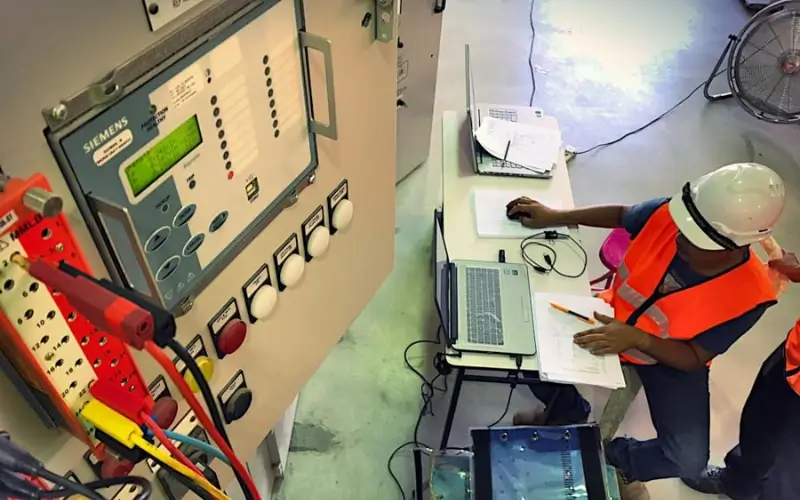
A commissioning manager performs duties of a forensic auditor to the project. They do not only ensure the presence of a generator in the room; they do it with full load. They do not merely look and know that the cables are connected, they carry out a test known as Megger to confirm that the insulation has not been destroyed. The process of moving towards a state of Trust to Verification is called Commissioning.
Validating the Design Intent
The electrical system of the building is an intricate ecosystem. The electrical plant design engineering package that was designed by the designers provided a logic on how the system would respond in case of an emergency. To illustrate, when a fire alarm is pulled, the ventilation fans are expected to be closed as well as the emergency lights to come on.
These combined patterns of performance are only tested when commissioning. These scenarios (also known as Integrated System Testing (IST)) will be physically initiated by a commissioning agent just to make sure that the design theory can bear its weight in the field. They discover the software bugs and wiring mistakes that otherwise would have been revealed in the case of a real catastrophe.
The “Gatekeeper” of Safety
Safety systems can only be useful when they are effective. A protective relay which is left in its factory default settings will not tend to clear short-circuit condition, and the explosion will occur or a fire will start.
Commissioning management will make sure that all the safety devices are checked and calibrated. This includes:
- Grounding and Bonding: Proving that the path to the earth is low-resistance to protect people from shock.
- Arc Flash Settings: Verifying that breakers will trip fast enough to minimize explosive energy.
- LOTO Verification: Ensuring that the physical lockout/tagout points are clearly marked and functional for future maintenance teams.
Creating the Operational Baseline
Commissioning Report is one of the most valuable deliverables of the process of commissioning. This is the birth certificate of the facility. It notes the precise performance of the equipment during the first day. Five years later, when a technician does some work on a transformer, he or she will be able to compare his or her present test results with the commissioning baseline. When there is a temperature that is 10 degrees above the temperature at commissioning, they will have objective evidence of failure in the transformer. Maintenance is no more than guesswork in the absence of this baseline data.
Training and Handover
The commissioning management helps address the distance between the operators and the builders. One of the key components of the commissioning scope involves training the staff of the facility. The citizens who will be in the system over the next two decades must know how to use the complex digital switchboards, how to reset the tripped breaker safely and read the energy meters. Commissioning will make sure that the keys are given to a confident capable team.
Conclusion
The final insurance model to a construction project is electrical commissioning. It converts a set of high-voltage equipment into a safe, efficient and operational property. With the investment in professional commissioning management, the project owners eradicate the so-called start-up risks of countless industrial facilities and guarantee that when they switch the switch the lights will remain on to this day, to tomorrow, and the years ahead.
Must visit: Baniyas Square Metro Station Dubai
C10 Bus Timetable Dubai
Emirates Tower Metro Station
Frequently Asked Questions
What is the difference between testing and commissioning?
Testing is a particular, single test on an element (e.g., test of resistance of a ground rod). Commissioning refers to the checking that everything functions as a complete system (e.g. checking the whole grounding network is protected).
Is commissioning mandatory?
In the case of critical facilities such as hospitals and data centres it is nearly always a mandatory requirement in order to be insured and to be in compliance. In the case of general buildings, they are strongly advised to safeguard the investment of the owner of the asset.
What is “Retro-Commissioning”?
This is the procedure of carrying out commissioning tests of an existing building which had never been commissioned or lost its efficiency with time. It is an effective means of locating some energy-saving and resolving long-term operation problems.
How much does a commissioning manager cost?
Ordinarily commissioning will be between 0.5 and 1.5 per cent of the overall electrical construction budget. Nevertheless, research indicates that commissioning recovers within a period of two years through minimized energy wastage and emergency repair evasion.
Who should hire the commissioning agent?
The owner of the building should employ a commissioning agent rather than the contractor to make them objective. This makes them remain loyal to the best interest of the owner and integrity of the design.