




Dubai Metro Blue Line Overview Route Stations Benefits
The efficiency, modern design, and smooth connectivity have long been known about the public transport system in Dubai. Another train, the Dubai Metro Blue Line, is to be developed, which will further extend this network and will become one of the vital main streams in the transportation system of the city. The Blue Line is expected to connect with the current Dubai Metro Red Line and Green Line with the aim of enhancing mobility to new residential, commercial, and industrial areas and thereby making day-to-day commuting easier for residents, expatriates, and even tourists.
The Dubai Metro Blue Line is not merely a transport project, but it represents the vision of the city on sustainable urban development and smart planning of cities. It also helps to address the growing need for effective public transport, giving the districts with high population growth rates in Dubai (underserved areas) direct connectivity.
Route and Coverage
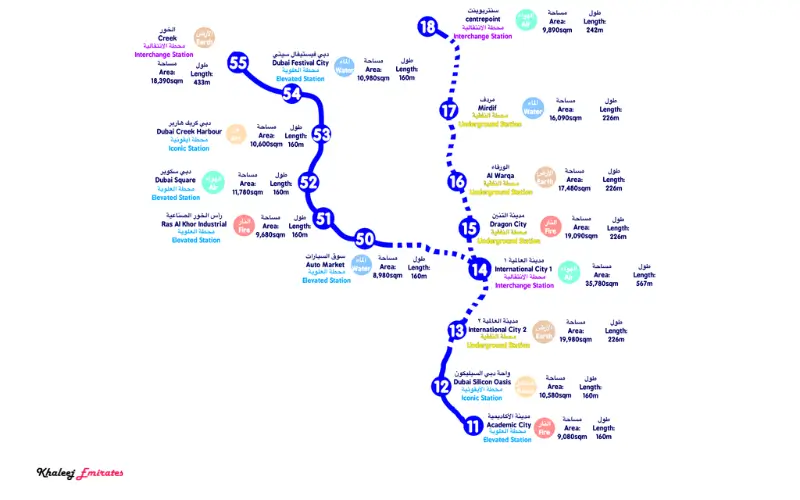
The Blue Line will span about 30 kilometers with a combination of both underground and overhead tracks to harmonize the urbanization and picturesque outlook. The line will consist of 14 strategically built stations to serve important neighborhoods and industrial areas. Among the top regions are Ras Al Khor industrial area, Al Warqaa, Mirdif, Dubai Creek Harbor, Dubai Silicon Oasis, Dubai international city, and Academic City.
The Dubai Creek Harbour Station is one of the most remarkable, which will be an architectural marvel, involving the elements of modernity and ease. The advantage of this long road system is that both residential and commercial areas are connected, meaning that people do not have to use their own vehicles as much, and it leads to improved traffic flow within the city.
Connectivity and Interchanges
Connectivity of the Blue Line is a significant benefit to the commuters. The exchange stations with the current Red and Green Lines, like the Centrepoint Station and Al Khor Station, allow the transfer of passengers between the different regions of Dubai easily.
The Blue Line also connects to the bus system in Dubai, besides having metro access. The metro stations are also connected to local residential zones, offices, and shopping malls by feeder buses, which offer the last-mile accessibility. There is also taxi services available even outside major stations, thus enabling passengers to access their final destinations easily, particularly in the case of night tiwhenere the frequency of the bus is low.
To make payment easier and provide customers with a comfortable experience in traveling, the NOL Card will support the Blue Line to the full extent, such that passengers can use the same contactless card on the metro, bus, and tram systems. This combined solution will make commuters feel convenient, reliable, and fast.
Construction and Timeline
The Dubai Metro Blue Line construction is an intricate construction project which is aimed at supporting the rising urban needs of Dubai. The project will be a fusion of both contemporary construction methods and good planning to reduce the disturbance in the areas where people. The line consists of both buried tunnels in more densely populated regions and overhead tracks in less crowded ones, and is cost-effective.
The scheduled finish time of the Blue Line is September 2029, which will be in line with the overall plans of the Dubai urban development plan. Some of the major milestones are the completion of structures, laying of metro tracks, and commissioning of stations. After the project is put into operation, the Blue Line should be able to handle thousands of passengers per day and alleviate congestion on the current lines, and also offer new transit choices to residents and tourists.
Facilities and Passenger Comfort
The Dubai Metro blue line has modern amenities, which make it comfortable and convenient for passengers. The trains are air-conditioned, and the high temperatures in Dubai are made bearable to thepassengerStationsons have escalators, elevators, and clear signs that make navigation easy.
The project has accessibility as one of its priorities. The Blue Line is inclusive and easy to use because of its tactile guidance tracks to enable visually impaired passengers, wide platforms, and specialized support to people with special needs. There will be parking areas close to large stations, which will help those commuters who want to drive to the metro and transfer their ride using the transport.
Benefits for Commuters and Tourists
The metro blue line in Dubai can be of great advantage to commuters and tourists. To the locals, it would save on the time taken to travel among major urban districts, industrial, and residential estates. New attractions and emerging areas can be easily accessed by tourists, which makes sightseeing and exploring the city more effective.
The Blue Line also helps in reducing the congestion of the Red and Green lines by linking underserved parts, making the ride a lot more comfortable and the wait duration less intense. To the expatriates who are able to travel daily, this amounts to reduced stress, increased dependability, and predictable travel. Also, the strategic path of the Blue Line opens up new business opportunities, since accessibility is enhanced by the employees and customers.
Environmental and Urban Impact
The Blue Line is consistent with the goal of Dubai to have sustainable urban mobility. It also promotes the use of public means of transport, which minimises the usage of private vehicles and thus minimises carbon emissions, and also alleviates traffic congestion. The long-term environmental objectives of Dubai include energy-efficient trains and stations, as well as sustainable construction.
Moreover, the Blue line is part of the Dubai 2040 Urban Master Plan, the theme of which is smart growth, integrated transport, and sustainable urban growth. The line provides an example of how contemporary infrastructures can integrate with environmental accountability and improve the quality of living of the residents.
Future Prospects and Expansion
As per the future, the Dubai Metro Blue Line is set to be expanded. The prospective extensions can link more neighborhoods, industrial zones, and business centers, consolidating the system of public transport system in Dubai. The projected large passenger capacity of the line will guarantee it will manage the future rise in the number of passengers in the next few decades.
Online collaboration and intelligent technology will improve commuter experience, such as the ability to track trains in real-time, purchase tickets by mobile phone, and better accessibility capabilities. With the city of Dubai continuously expanding into a global city, the Blue Line will be at the center of building effective, sustainable, and inclusive urban mobility.
Travel Tips for Commuters and Tourists
To those who intend to utilize the Dubai Metro Blue Line, there are a few things that can enhance the travelling experience. An NOL Card will allow one to treely the metro, bus, and tram freely. Interchange stations, such as Union and should be planned by the passengers.
To have a more comfortable ride, it is better to travel during the non-peak time (not 89 AM and 57 PM), when there are no crowds, as during the peak times. By observing metro etiquette, including maintaining silence in the specific cabins and priority seatinforto older people and women, all passengers will have a good experience. The tourist pass is an ideal product to offer tourists who want to use the metro to visit several attractions and have unlimited access to the metro within a day.
Conclusion
The Dubai Metro Blue Line is one of the significant advancements in the transportation system of the city. It links new residential, commercial, and industrial areas, thereby enhancing accessibility, minimizing traffic jams, and promoting the vision of smart city development in Dubai. The Blue Line, with its modern facilities, availability of stations, and smooth integration with the existing transport systems, will become a significant part of the lives of the residents, commuters, and tourists alike.
Since Dubai is growing, the Blue Line will not only offer an effective way to commute but also demonstrate Dubai’s willingness to develop, innovate, be sustainable, and inclusive in its urban development. Passengers are guaranteed a convenient, comfortable, and reliable ride in the metro regardless of their destination, be it work, recreation, or sightseeing, and thus the Dubai Metro Blue Line has become a pillar of the future transportation in Dubai.
FAQ’s
What is the Dubai Metro Blue Line?
Dubai is a proposed metro line that will connect the important residential, commercial, and industrial neighborhoods of this city.
How long is the Blue Line?
It is supposed to span some 30 kilometers, having underground and overhead tracks.
What will be the number of the Blue Line stations?
The Blue Line will have 14 strategically located stations.
What are the significant destinations on the Blue Line?
It will cover such regions as Ras Al Khor Industrial Area, Al Warqaa, Mirdif, Dubai Creek Harbour, and Dubai Silicon Oasis.
When is the Blue Line scheduled to be in operation?
The RTA in Dubai has not mentioned the official opening date.
Does the Blue Line have any other connections with other metros?
Yes, it will be connected with the Red and Green Lines to enjoy a smooth ride around the city of Dubai.
Will the parking be in the Blue Line?
The majority of large stations are supposed to contain parking lots for commuters.
Would the Blue Line be tourist-friendly?
Yes, it will have the linking of the common tourist attractions and business centers, which will make it easy for the visitor.
The category of trains to be used in the Blue Line is what?
Modeled, fully automated trains such as the Red and Green Lines will be used on the line.
Is it possible to take an NOL card on the Blue Line?
Yes, the NOL card will be applicable in all the stations within the Blue line of Dubai.