



The Invisible Lifeline: Cable Performance in Critical Healthcare Facilities Across the Emirates
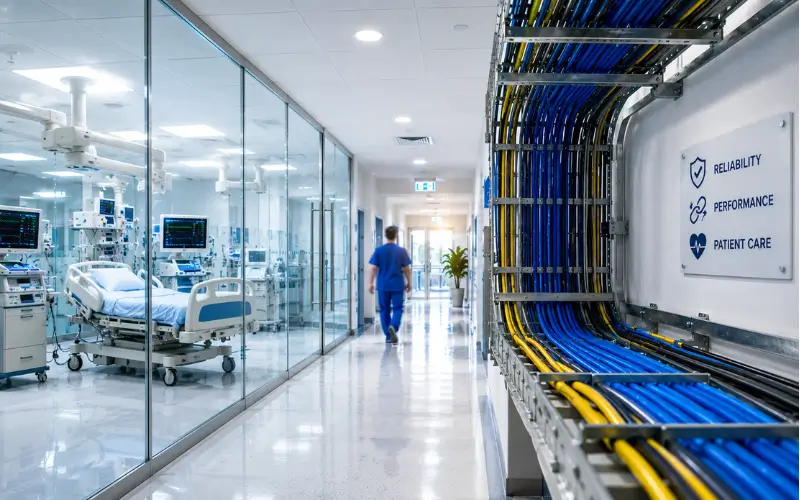
Whether you’re at the cutting edge of Dubai Healthcare City or the much-admired wards of Cleveland Clinic Abu Dhabi, technology is the silent force that works alongside every healthcare professional. The Ecosystems in these facilities range from the ventilators in the Intensive Care Unit (ICU), to the MRI machines in radiology, to the digital health records at the nurse’s station. The region is seeking ways to reduce its energy consumption through sustainable alternatives, but at heart, hospital engineering is about reliability. Hospital engineering is about reliability, yet the region is focused on reducing its energy footprint with sustainable alternatives. Cables in this context are not merely a technical parameter, but a key aspect of patient safety and life-saving.
1. The Power of “Always-On”: Redundancy and Reliability
A power outage is a nuisance in a residential building. It can be a disaster in a UAE hospital. Systems such as neonatal incubators and heart-lung machines cannot tolerate any loss of power for more than a blink of an eye.
When designing a hospital cabling system, redundancy is the key principle.
- Dual-Feeds: Usually two separate cable paths are provided for each critical room, one known as an A-feed, and the other a B-feed. When one cable has been damaged or broken, the other will immediately compensate.
- Isolated Power Systems: Isolated power systems are found in critical areas such as operating theatres, providing “medical-grade” power. The cables that feed the sensitive areas, whether they are massive feeder cables or standard low-voltage cables for equipment and lighting, must have extremely high insulation resistance to prevent even small leakage currents, which might be harmful to a patient during surgery.
2. Beating the “Noise”: EMI Shielding for Medical Imaging
Medical imaging equipment like MRI and CT scanners is very sensitive. These machines, with strong magnetic fields and radio waves, can peer into the human body and provide crystal clear images.
The problem? Routine power lines that go through the walls have their own electromagnetic fields. If not adequately shielded, these power lines generate “noise” that can appear as artifacts or “ghosts” on a patient’s scan, possibly resulting in misdiagnosis.
Solution: Cables with special protection. These cables are constructed with heavy copper braids or foils that help keep the cable’s own electrical noise contained, thereby helping to ensure the imaging signals aren’t obscured by outside noises and are therefore diagnostic.
3. Fire Safety: The LSZH Mandate
Hospitals are special in that some of the users of the hospital facility are unable to walk on their own to any emergency exit. The evacuation of a hospital requires time and the transporting of patients in wheelchairs or on gurneys. The worst part of a fire is often not the flames themselves but inhaling the smoke and panicking.
- Low Smoke Zero Halogen (LSZH): Cables in the critical areas of hospitals should be LSZH, in accordance with the strict UAE Fire and Life Safety Code of Practice. Traditional PVC cables will burn with heavy, black smoke and toxic gases (such as hydrogen chloride) that can cause blindness to patients and prevent staff from directing an evacuation. LSZH cables emit very little smoke and no toxins, giving valuable time to evacuate patients safely.
4. Fire Survival for Life Safety Systems
Critical cables not only need to be smoke free, they need to remain operational when in flames.
In the event of an actual fire, critical circuits such as the fire alarm, smoke extraction fan, emergency light, and firefighter lift systems need to function to avoid a localized emergency situation turning into a disaster situation for the entire facility. Contracting companies are able to satisfy these very strict requirements by using dedicated fire alarm cable suppliers in uae that provide high-quality fire survival cables. These types of cables use a copper core with mica tape surrounding it. Even if the plastic insulation is melted away, the Mica will form a hard ceramic coating and will prevent the possibility of a short circuit, ensuring critical hours during a fire are spent with the safety systems operating.
5. Signal Integrity for Digital Health
A modern UAE hospital is a “Smart Hospital.” Each bed is equipped with several sensors which feed into a central monitoring system that is AI-assisted. A very high-quality data cabling infrastructure (Category 6A or Fiber) is needed.
Poor quality data cabling can result in “false alarms” for nurses—when they receive an alarm, but it turns out to be unnecessary—or even “missed alarms,” when they fail to receive an alarm when it is needed. When a patient’s heart rate fluctuates, the alert is immediately relayed to the doctor’s tablet, no matter what, with high-performance data cabling.
Conclusion: The Veins of the Hospital
A hospital is said to be like a living being. The cables are the veins and the nervous system; the doctors are the brain, and the equipment is the muscle. They bring the life-giving power and the life-giving signals which enable modern medicine to have its magic. Khaleej Healthcare engineers have taken measures such as prioritizing high-performance insulation, robust EMI shielding, and the highest fire safety standards to ensure our hospitals are sanctuaries of safety. The quality of wire is much more important when lives are at risk.
Must Read: Knowledge Village Medical Fitness Centre: Fees, Tests, and Processing Time
Your Healthcare Cabling Questions Answered (FAQs)
Why is MRI wiring so special?
The MRI machines employ very tiny radio waves. The picture could be ruined by any electrical “noise” from a normal power cord. Specialized non-magnetic cables and heavy copper shielding in the MRI rooms create an electronically silent environment.
What is an “Isolated Power System” (IPS)?
IPS is a system of electricity specially designed for operating rooms. It helps to keep the power from going out in case of a single electrical problem. Rather, an alarm signals, and the surgeon is allowed to complete the procedure in a safe fashion before the problem is corrected.
Can you use regular Ethernet cables in a hospital?
Yes, in administrative offices. In areas used by patients and imaging workstations, however, “shielded” Ethernet (F/UTP or S/FTP) is required to avoid interference from medical equipment and to guarantee the high-speed data transmission of patient monitors without any dropouts.
Why is smoke more dangerous than fire in a hospital?
The majority of those in a hospital are unable to get out of their rooms easily. Smoke moves much more quickly than flames in a fire through vents and corridors. If the cables give off toxic smoke, it may disable patients in other parts of the hospital before the fire actually arrives at their location.
How often should hospital cables be tested?
Strict biomedical engineering procedures are followed in UAE hospitals. The “patch cords” and visible wiring for medical equipment are subjected to an intensive test of insulation resistance and earthing every 6 to 12 months, while the wiring below ground is permanent.